Big cities don’t grow by accident. They grow through planning, investment, and long-term confidence.
And when a city like Dubai makes a long-term commitment, it’s worth paying attention to what it signals.
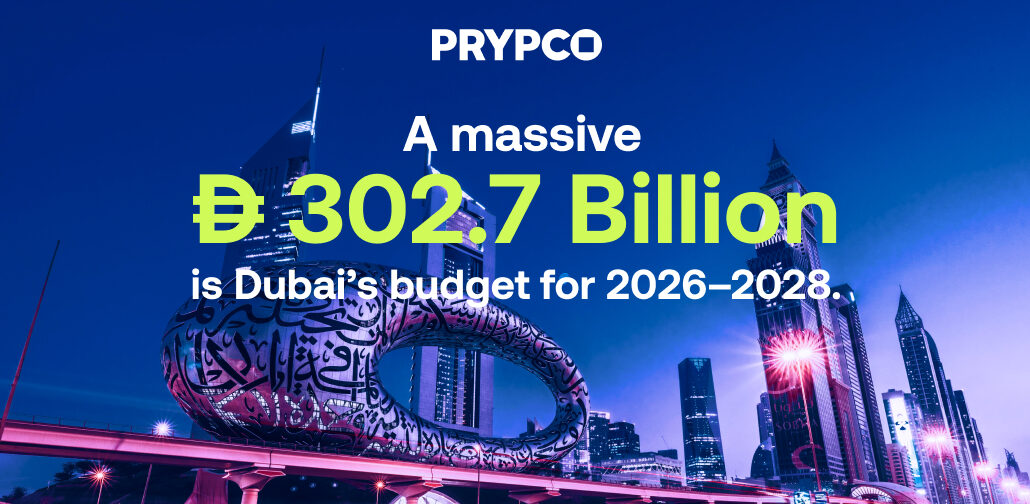
That’s why Dubai’s newly approved AED 302.7 billion budget cycle for 2026–2028 is more than just a headline. It’s one that speaks to where the city is going and how it intends to strengthen the systems that shape everyday life.
To understand why that matters, it helps to look at how markets typically respond to government-led planning.
And historically, when governments invest at this scale, one sector tends to respond quickly: real estate.
In this blog, we break down what Dubai is investing in, why it matters, and how this kind of government-led growth can shape property demand, opportunity, and long-term stability.
Let’s start with what makes this budget cycle significant in the first place.
A record budget, built around long-term priorities
Dubai’s budget cycle for 2026–2028 totals AED 302.7B, making it the largest multi-year budget plan the government has announced to date.
That number matters not simply because it’s large, but because it reflects a strategy: investing in the foundations of a globally competitive city while maintaining financial resilience.
And that strategy becomes clearer when you look at the timeline behind it.
Rather than short-term spending, this cycle is structured planning. It’s about shaping the next phase of growth, and doing so in a way that reinforces Dubai’s reputation as a stable, future-focused environment for residents, businesses, and investors.
So what, exactly, is Dubai prioritising within this plan?
Where Dubai is investing (and why it matters)
Dubai’s budget priorities are concentrated in areas that influence how a city functions, evolves, and attracts residents.
In other words, this is investment aimed at the fundamentals – not quick wins.
The allocation includes:
48% → Infrastructure & construction
28% → Community & social development
18% → Security & justice
6% → Digital government
Together, these categories paint a picture of how Dubai wants the city to grow.
These categories aren’t random. They strengthen the city’s core value drivers: connectivity, liveability, safety, and efficiency, all of which directly influence real estate demand over time.
And when these drivers strengthen, the effect tends to show up clearly in the property market.
What Dubai’s 2026–2028 spending could mean for real estate
Every market is influenced by multiple factors, but the themes in Dubai’s budget cycle point to several meaningful real estate implications:
Here are three that stand out most clearly.
- Transport and metro expansion can unlock new high-demand zones
As transport networks expand, areas that were previously “further out” become more accessible, which can increase both buyer and tenant demand. - Community investment can strengthen rental demand and stability
Investment into social development doesn’t just improve lifestyle, it strengthens community value. Better services and stronger amenities can translate into higher demand and longer tenant retention, supporting steady rental performance. - Smart and sustainable infrastructure supports long-term resilience
Dubai’s focus on digital government and infrastructure development reinforces long-term competitiveness.
And long-term competitiveness is often what separates short cycles from sustainable growth.
Assets aligned with future priorities often remain relevant, especially in cities building for long-term global positioning.
But even with a strong budget, the question many people ask is: how do you access it?
Accessing Dubai real estate doesn’t need to mean buying an entire property
For many people, the biggest barrier to real estate isn’t interest – it’s access.
Dubai is one of the world’s most dynamic property markets, but traditional ownership often requires significant capital and higher entry thresholds.
That’s why alternative pathways matter – especially in a growing city like Dubai.
This is where PRYPCO changes the equation.
It’s about participation without needing to take on the full cost of entry.
With PRYPCO, you can participate in Dubai real estate through multiple pathways, including:
Fractional ownership, allowing you to invest without purchasing a full property
Mortgage solutions, designed to make ownership more accessible
Support for long-term residency and Golden Visa opportunities
A platform designed to help agents buy, invest, and grow within one real estate ecosystem
These options are designed around flexibility and around long-term planning, not short-term trends.
Which brings us back to the bigger point behind this entire cycle.
Final thought: this is about the future Dubai is building
Dubai’s AED 302.7B commitment for 2026–2028 reinforces what many residents and investors already feel: Dubai is not standing still. It is building deliberately toward a future shaped by infrastructure, community development, safety, and digital progress.
And for those looking to be part of that future, real estate remains one of the most direct ways to participate.
The opportunity isn’t just in owning property – it’s in aligning with the direction of the city.
This isn’t just about investing.
It’s about owning a share of Dubai’s future – starting today.
Sources
- Dubai Media Office / Department of Finance press release: “Mohammed bin Rashid Approves Dubai Government’s General Budget Cycle for 2026–2028” Public Debt Management Office
- Reuters coverage of Dubai’s 2026–2028 budget cycle and allocation breakdown Reuters